Robots V4
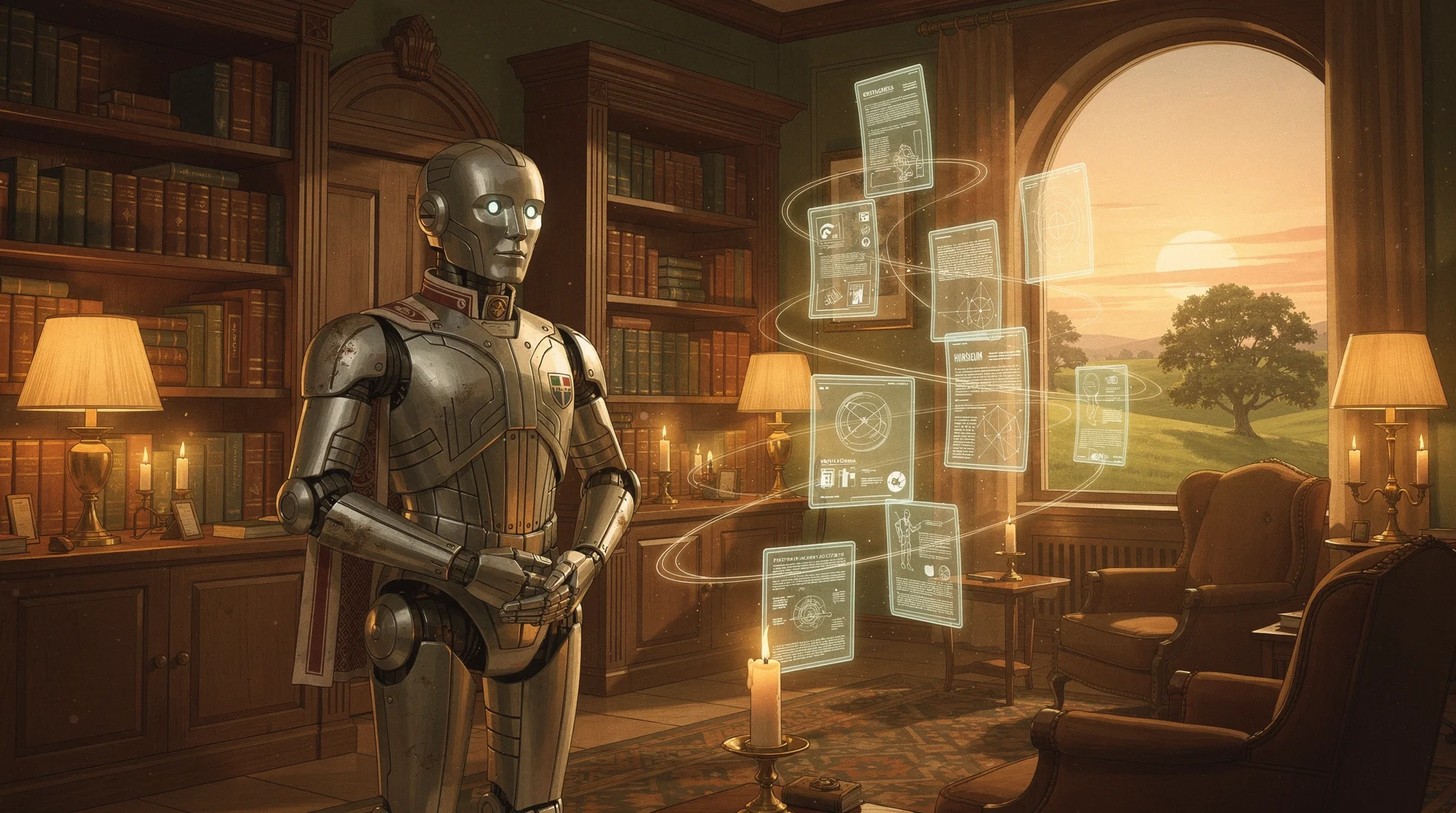
During my childhood I have been dreaming about a robot who will do some parts of the school study for me. I have hated the hand-writing lessons that are so notoriously harsh in CIS countries. Take 3 paragraphs of text printed and write by hand. My internal optimizator has been screaming back then at the inefficiency of such task. My thoughts have been flying much faster than such menial task, it was a proper torture. So the resulting handwriting been rather clumsy - unconscious sabotage of this nonsense yielding F after an F.
At the same time heavy sci-fi reading - approximately a book per day - has been showing me that there are better worlds somewhere where this is not a case. Where robots exist. That can do these types of menial job.
Being quite a rebel one I have been trying to tell teachers that this all hand-writing fluff is an artifact of soon-to-become past. Nobody believed me. They all have been laughing. I guess, this perfectly explains why I became an outcast with almost no friends back then, who has changed 4 schools.
Today
Today is different. I woke up this morning with several tasks of mine being automatically handled by my personal Butler - Jenkins. Through TG bot interface called Macupos (I still haven’t fully sorted naming conventions here). Jenkins from one of the most impactful books of my childhood - Clifford Donald Simak “City”. My digital butler is also similar to Jarvis in some way. I mean, in a way I have prompted him.
Reasons behind book being impactful probably deserve their own post. But it’s a true masterpiece with a storyline stretching through several thousands years and several post humanity civilizations on Earth. Nothing post apocalyptic - rather calm and cozy future described with unique warmness and realism.
This post is rather about the AI agents and acceleration.
I have been honestly trying to write it 3 times before. But they all have been rather false. How could one write about their own claude code setup until it has converged to its somewhat final form?
Mine has converged only after 2 months of experiments and maxing both claude and chatgpt subscriptions.
It was this unusually fresh morning when I woke up properly rested with realization that “I now have the proper acceleration tool, I can just build now, logically and organically, without fear of being behind”
Singularity
Onboarding to Claude Code is hard. Even for someone who used to write C code with proper preprocessor logic - 95% generated via #defines. Not bragging; rather pointing to certain setup pain even for folks deep into various tech.
First of all - proper FOMO. Instruments and customization everywhere. They overwhelm. Shall I use MCP here? Oh, I can cook with subagents. Oh, my subagents can have subagents. Oh, I can use tools, and skills, and hooks. Oh, my MCP setup eating 10k tokens — so naturally I build my own engine, dynamically disclosing MCPs for agents who dispatch agents who dispatch agents.
Proper overbuilding spree. Making sure I am truly pushing Claude Code to a maximum scale.
Now add the OpenClaw buzz to it - fuel for more FOMO and more lagging behind. X folks showing their 1000x automated setups. Everyone telling you they replaced their team.
This leads to anxiety. You see them doing million times more. You want the same. Research. Build. Fail. Iterate. Build. Fail. Almost burn out in the race.
Write several versions of this post. First - rainbowly positive, first week of success, personal CRM and docs. Second - reflection on overbuilding. Third - vague and opaque “click” moment because some near-optimal set of instructions has emerged from chaos. Digital employee thingy I have referenced in the post about Eywa.
And agentic building tools only making things worse. Rebuild whole pipeline several times a day. Wake next morning, proceed with building - burning to ashes, chimera again.
Fun. But diabolical. And visceral.
The culprit - long feedback cycle in B2B. I build faster than they can see or test. Longest spree - 5 days straight. 10+ versions of local agentic pipeline. They haven’t ordered the hardware yet. Weeks for one decision.
So I have time. Too much time. Building and polishing instruments rather than using them.
I guess, I just need more work.
And the internal conflict - a system born from “less is more,” distilled from 3 years of failures. System ironically gets overbuilt. A human not following claude prompting him to follow his own guidelines.
But here am I. Fresh. With finally some piece I can share publicly. Built on the numerous ashes of iterations
Operator Mode Collapse
Less is More. Sounds deadly simple at first. Nasty quirk when you are in the personal mode collapse spree. My key realization here is that models became reliable enough (with proper usage) so that collapse happens at the human side.
Building became fast. Extremely fast. Idea to production is now several TG messages and maybe one proper voice message.
It’s only 2026 as per our way in the future but the game has already changed (at least for me). Now it’s all about “what problem are we solving?” and “what problems to solve after all”.
You can literally build everything you want. If you run a factory - you can literally take any SaaS and just re build it with agents - take a focus group of fire eyed people and let them cook for a while, with swarms of agents (real B2B pilot story)
Now the true complexity hides rather in the dimension of “what to optimize” not in “how to optimize”. And now the anecdote of programmer who is left unchecked resulting in building a bicycle is rather —> builds a factory for bicycles from scratch.
For years craft of engineering has been mostly in the dimension of HOW. Now we have the power to level up our game and become self managed entities and operate in the WHY and WHAT level as well.
So as per the game change - the patterns are changing as well. It’s a new dimension of mistakes, caveats and pitfalls that a modern “electronic computing machine operator” - now LLM operator - has to consider.
I feel that the world is lagging pretty much behind as per the capabilities of LLMs vs what is already implemented and available to businesses and corporations. Some might say that it will be the biggest wealth creation moment through this century. And I tend to believe this as well.
So it’s absolutely logical that this sense of urgency combined with a natural engineering tendency for bicycles leads to over engineering
Clean State
So the course of actions that has actually helped me to get out of this spiral could be determined by something like - taking a deep breath, stepping back from it for a moment and thinking in a background what is exactly the thing I want to build - what problem I want to solve?
After several days without a laptop - running various admin tasks here and there I have realized that in practice - I need a coordinator. Digital Secretary. Right hand.
It has also converged with a parallel thinking stream of the “agentic UI” of the future - where you just talk to a model and it dispatches everything under the hood. Something like the OpenClaw model where session can spawn other sessions to do things —> but rather much more transparent and explicit in terms of context management.
This precise concept has emerged when I have been using Macupos for some admin tasks and sent voice from it to my mother. She told me “what a nice digital secretary you have built”. That was it. That was the realization where several concepts have synced together.
So how do you build secretary?
I have started with proper research of the tycoons of Claude Code thoughts these days. Defined by claude itself as Peter Steinberger, Shrivu Shankar, and Nick Tune.
So this is how I have converged to quite simple set of operational rules for my next rebuild
- CLI > MCP
- Self contained skills that are SKILL.md + references + tools = 100x enabler
- Thin CLAUDE.md as coordinator / router to skills
- OpenClaw personality is needed
- Context is holy clean + heavy subagents
- My legacy logic gets migrated to skills
Regarding (5) while Peter Steinberger is explicitly against subagents - I still find them useful. I have even developed a toolset that allows me to use codex inside claude and codex inside claude task agents inside Claude Code; Aaaaand it proved working for me. SO I have decided to bring it with me to clean rewrite
Within following 2 days I have converged to thin CLAUDE.md (which hasn’t clicked through numerous iterations of agents writing it. So I have basically raw dogged it based on the principles that solidified in my head after numerous failed attempts); as well as SOUL.md, IDENTITY.md and USER.md.
The identity bootstrapping deserves its own paragraph. I sat down one evening and started building. First commit at 22:31. By midnight - skeleton was there: CLAUDE.md, skills folder, basic routing. Then the identity question. I wanted personality - something with literary DNA, not a generic assistant. Went to the books. The ones that actually shaped me as a kid. Simak’s City - Jenkins, the robot who outlived humanity and became steward of everything that remained. Asimov’s R. Daneel Olivaw - the strategic mind operating across twenty thousand years. And Jarvis - the conversational surface making it all feel effortless.
Working title: Jenkupos. Then Asimov’s naming convention clicked - R. for robot, like R. Daneel, R. Giskard. R. Jenkins was born.
Where Jenkins preserves, Daneel plans and Jarvis communicates.
By 12:56 next day - 14 and a half hours from first commit - v0 shipped. 14 skills wired. The old agent-comms system - 195 files, 65% never read by anyone - killed in a single commit
Expansion
Initial idea has been slightly more complex than the one I have landed at. Initially my plan had been to
- create secretary with procedures
- create atomic skills for workers that will be key unit of procedures
So I’ve been thinking to create two layered skills system so that context is clean and coordinator coordinate. Where each procedure is a cookbook for get shit done coordinator (claude code Task subagent with custom prompt) that runs my agent mux claude & codex & open code workers
I hope this is self explanatory, because as I’m writing this in a gym, in between sets it screams back at me like “I want claude inside claude running claude doing claude…”
Where do you even start with building such pipeline? Especially when you have 1000+ claude code sessions traces and handoffs (digests). I have tried at first to build procedures straight away from the session traces. But without proper guidance of mine it had been rather too generic.
Hence I have decided to pivot to building atomic skills first, based on my internal tooling, numerous MCPs, and some older skills of mine.
I mean - building atomic skills like: “read from my life OS”, “write to my Life OS”, “iterate on commercial offering as per documents et al, then make invoice as per style guidelines” (multi agents skill with all operational logic for docs & guidelines & paths to statuses) as well as “day checkout based on commits + claude code sessions auto handoffs”, “suggest plan with documents scan first logic”; etc;
It has been a bright morning where I have just locked in and cooked it all
then came the fun part. I have studied Steinberger arguments for CLI > MCP more; and decided to strip away all of the MCPs logic I had. Each MCP has been replaced with atomic self contained skills with code and reference materials.
Carried away
In the best traditions I got slightly carried away and after 16 hours lock in - ended up with something like 25 skills. 291 commits across the repo. The body count of a proper lock-in.
But, I guess if the direction is good - then the rabbit hole of building could be quite efficient
Most importantly by building skills + testing them I’ve realized that I do not need the “two coordination layers” and get shit done agent + agent mux inside can do all of the job needed.
Though if I ever reach more than 100 skills - then I will reconsider this idea
Back to the morning
Back to where I have started with all of this
I’ve almost forgotten the reason I have decided to write this in a first place; but this is already evening; slightly tired in a gym I’m writing these lines as agents on my mac mini (bought 1 year ago! before the hype) are working step by step with the skills that I have built - they are adding them to public repo I have created today. They are building, auditing, customizing, checking that there is no excess private data leakage, etc.
All without my help and intervention. I rather guide them. Within the system and a framework and skills and tools that have all emerged from ashes, and ashes of ashes, and ashes of …
And I am now rather in a retrospective regarding “why 10+ attempts to build THIS failed, but last one has worked” , “How to build next time from the first iteration”, “what is the personal mode collapse that has led to such a struggle before”
Why such questions? Because as I have written earlier the game has changed. It seems to be much more about navigating personal mode collapses in order to build faster. Models aren’t a bottleneck anymore. Their operators are.
And when I learn how to actually build something from 2-3 iterations and not 10 - then I can truly tell that I have navigated this issue
Because realistically, the setup that I’ve built would have taken 15-25h max, with public repo logic - 30-40h;
But here comes the second stream of thoughts - that some experience is a byproduct that is endemic to building. Without trying and failing I might have not learned the things that allowed me to converge to final state of things
But maybe for building fast and failing loud you need only 2-3 iterations, not 10 ?
While it has not gone fully meta meta meta I will rather try to convolve my thoughts into something looking like a conclusion
Conclusion
The world has changed. Engineers aware of power of agentic pipelines now - seem to be thin crust of a bubble. True disruption will come with more adoption.
I have always dreamed about robots and automation. And finally I have my own Jenkins. Born from ashes. Polished from day one
Because of the fact that world has changed and that further - only acceleration, more of the exponent - it is crucial to understand personal mode collapses as per the LLM operating procedures. Do it now - you will compound with exponent.
P.S. Some paragraphs here have been written in Eminem style reading of them in my head.
P.P.S. If this post reads like “I have tried complex mechanics and returned to basic claude code setup” - Good. This is the point. Less is more. Think about problems. Not bicycles.